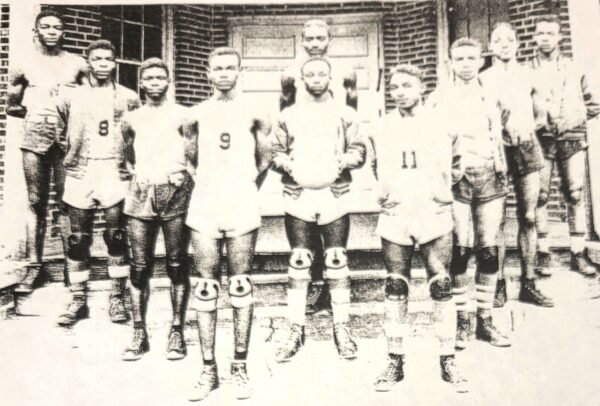

The teams of Whiteville Central just recently celebrated their State Championships from 1967 and 1968. These titles came in the segregation era, which often leaves them overlooked or sadly just forgotten. Before those winning seasons near the end of separate schools, a Whiteville Central team had already made history.
Tucked away in the basketball history of the N.C. High School Athletic Conference (NCHSAC) and the black high school basketball championships is a simple entry.
Basketball state championship games: 1947
A-Laurinburg Institute 56, Gastonia Highland 37 (March 26 at N.C. College, Durham)
B-Whiteville Central d. Charlotte Plato Price (March 26 at N.C. College, Durham)
Whiteville Central had won an earlier championship in basketball, and very few people seem to know about the championship or the score.
Research on the game ran into a few brick walls. Records at the time were not as important or kept up with. Lots of articles and files were not put on microfilm or discs. Paper rots and fires happen and history is lost that way. Newspapers were owned or influenced by members of the Ku Klux Klan in some of cases, and no articles about black people were included in their publications. And death takes away the ones who lived these adventures.
The team’s historic win over a larger school is just one part of the history of education during segregation.
In the early 1900s, Rosenwald schools for black children were being built throughout the South. Julius Rosenwald was the president of Sears and Roebuck, and wanted to enhance the quality of education for black children. He teamed with educators like Booker T. Washington to build these schools for that purpose.
One obstacle to research is that Rosenwald Schools often had numbers, not names, at the start of the 20th century. For example, Artesia Hallsboro was School Number 38. Later most of these schools were called Negro schools. Whiteville Central was called Negro High School in 1947. Central High School didn’t become the school’s name until 1950.
Calls to several newspapers in the Charlotte and Salisbury area and a few history professors turned up little information. The lack of information wasn’t just for Central – it was a struggle to find out anything about Central’s opponent, Plato Price. Records show they were out of Salisbury and they won some titles in football and basketball during the NCHSAC era.
Joseph Price, founder of Livingston College, had a high school in Salisbury named after him, Joseph Charles Price High School. News articles showed that they lost to Negro High School out of Whiteville, in basketball in 1947.
In the 1930s and 1940s, many high schools didn’t have basketball teams, much less any gyms. They played on dirt courts. Chicken wire around the basketball courts to keep the spectators off the court. This was where the term “cagers” came from for basketball players.
In the early 40s, basketball was becoming a phenomenon among blacks as well as whites. Coaches like John McLendon at N.C. Central (Central College of North Carolina) taught kids fast break basketball that they still use today. Three seconds and a shot is off – the technique is still common and can be seen in the NBA today.
Coach McLendon’s style of ball was spreading among the black high schools. In 1944, Central met Duke, the all-white team and number one team in the country, and ran them out of the gym.
This would be the same gym that Negro High School of Whiteville would run Plato Price out of just a few years later.
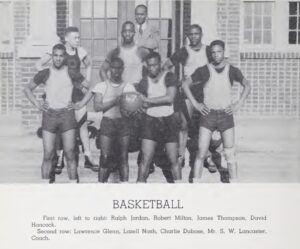
The 1947 Platoan, a school annual, held some information about the team. While many black schools didn’t have much money for books, much less an annual, Plato published a yearbook that included their athletic program.
The Price team was coached by Spencer Lancaster. The players called him “Professor”. He knew a little bit about football too, as he was the all-time winningest football coach in their history (183 wins) with two state title and two undefeated seasons between 1940 and 1952. Members of the Price team were Ralph Jordan, Robert Milton, James Thompson, David Hancock, Lawrence Glenn, Lazell Nash, and Charles Debose. News reports claimed their team was undefeated and putting up over 80 points a game in the McLendon offense.
Louise Turner was a former student (class of 45) and long-time teacher at Central High School. She also is a little bit knowledgeable about basketball: she won a state championship as a girls coach at Wilson High School in South Carolina in 1950.
Mrs. Turner said that Negro High School (Whiteville Central) was led by Coach Legrande Summerset. Coach Summerset’s squad had an advantage on most black high school basketball teams in 1947. They had a gym.
The school did not build a gym until 1950 but had use of the Whiteville VFW building, which had a full court gym. It was only two blocks from the school. This is where Coach Summerset planted the seeds of greatness. They only lost one game that year, playing area opponents like Artesia (Hallsboro), Booker T. Washington (Clarkton), and Douglas (Tabor City) on their way to the championship.
On March 26, 1947, the Eastern Champions, Negro High School of Whiteville (21-1), left in cars driven by parents, teachers, and faculty to College Gymnasium of Central College of Durham. They raised the money to take their team to Durham.
“There were no boosters,” stated Turner. “No chartered bus, no parade, no fans, and no pre-game meal. Just a group going to play a ballgame.”
In Durham, there would be more than 2,000 fans packed in a gym waiting for two basketball games that night: Laurinburg Institute vs Gastonia Highland and Whiteville Central vs Plato Price.
Most people in the Gymnasium at Central College (its real name) were there to see Laurinburg Institute. They crushed Gastonia Highland 56-37 and were already getting a reputation among black high schools for basketball excellence. The ones who watched the Central vs. Price game were expecting a Plato Price victory, as Price was the Western Champion team. Media reports tell of a high-scoring athletic team that was blowing out opponents.
But Coach Summerset knew something about Coach John McLendon also. He knew of the four corners.
Most people think UNC legend Dean Smith invented the four corners. It was John Naismith, the inventor of basketball, who invented the technique and taught it to Coach Smith and Coach McLendon while both studied at Kansas. Coach Summerset knew he couldn’t run with Price so he ran a stall game: the four corners.
Central fell behind early by 10 points but came back to tie it at the half 16-16. Central outscored Price 14-4 in the third and led by as much as 14 in the fourth quarter. The four corners led to layups and consumption of time, keeping the high-powered Price offence in stall mode. Negro High School of Whiteville defeated Plato Price 43-32.
Reports say the crowd was stunned by the play of the team from Whiteville. John Johnson led Whiteville Central with 16 points. They finished the season 22-1.
Whiteville Negro High School came home to no parade and no crown, just the satisfaction of winning a game. The score isn’t even listed in the history of NCHSAC Champions.
On Wednesday March 30, 1947 the team was honored with a banquet. Fayetteville Teacher’s College assistant basketball coach L. R. Robinson was the guest speaker. Bolton Elementary School Principal Fred Corbett presented each team member a wool Marlboro dress shirt for their victory. The banquet was filled with talk of pride and good sportsmanship.
The members of the 1947 Negro High School of Whiteville Basketball Team are Joe Lyons, James Ford, John Robertson, Aaron Troy, Jr., Oscar Edwards, Jr., John Johnson, W.P. Kelly, McNeil Peterson, Charles Torrence, Fletcher McNeill, Eugene Mack, and Coach Legrande Summerset.
The Central High Alumni Association is ready to celebrate and receive their championship plaque from their title many years ago. The alumni hope to get the school to be listed among the National Registry of Historical Places in North Carolina.
And when it comes to black high school basketball excellence in the state of North Carolina, Central High School with its three state championships, deserves to be listed among the great basketball teams of the times, like Laurinburg Institute, Elm City Douglas, Durham Hillside, and the others.
Copyright 2026 Columbuscountynews.com. All Rights Reserved.