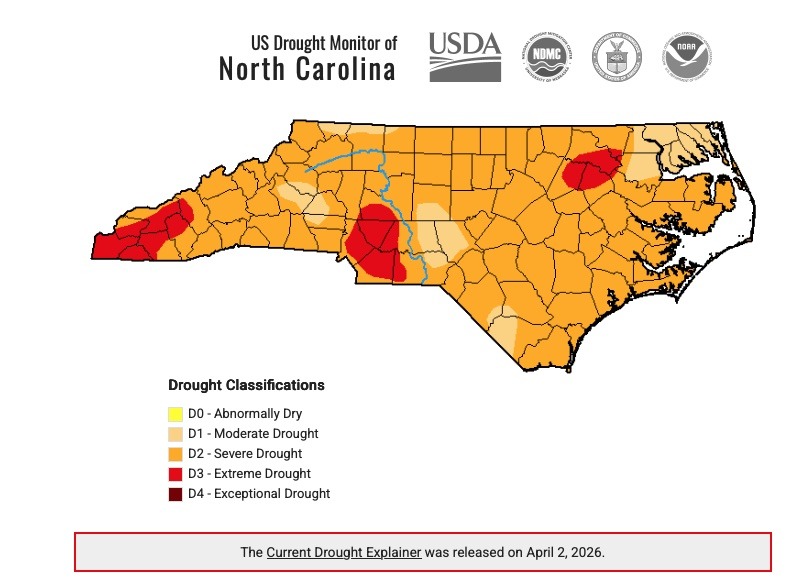

The latest N.C. Drought Monitor was released today (April 2) and there’s no good news.
Columbus County is experiencing D1 (Moderate) in the west and D2 (Severe) conditions in the east. No significant rainfall is anticipated for the next week.
Currently, the area has an aggregate rainfall deficit of more than 18 inches, according to the National Weather Service.
The state, county Fire Marshal and municipal authorities have issued burn bans that went into effect Saturday. The “grace period” – where fires would not earn a fine and a citation – ended Monday.
Starting a fire of any kind outdoors will result in a $100 fine plus court costs, said Rodney Freeman, the law enforcement agent with the local N.C. Forest Service office.
“If the fire gets away, the cost is much higher,” he said.
Even when there is not a burn ban, a fire that gets out of control can result in the person responsible facing suppression costs in the thousands of dollars, as well as civil action.
Conditions are unlikely to improve in the near future, officials said. The U.S. Drought Monitor expects drought conditions to last through the spring.
“Outlooks from the NWS Climate Prediction Center show that drought will likely persist through the spring months,” Whiteville Emergency Manager Hal Lowder Jr. said in a briefing email today. “Given the accumulated rainfall deficits over the past six months, drought may linger even if rainfall were to return to near normal values.
Surface water sources such as ponds, swamps and rivers are getting low, according to the National Weather Service. Public water supplies are not being affected at this time, Lowder said.
“I do not anticipate any restrictions currently, since we do not rely on surface water, and our aquifers are in good shape,” he explained.
Last year’s hurricane season was active, but had no real impact on the region, Lowder said. Combined with the extremely dry weather, fire conditions are critical.
“It may ultimately take a tropical system to replenish the region’s moisture,” he said. “Nobody wants that.”
District Forester Michael Rhodes said current conditions are dangerous.
“What we need right now is for people to keep their matches in their pockets,” he said.