I was walking down the street in a small town when a poster took me back to a most wonderful summer.
The poster was faded and uneven in a dusty plate glass window; like the long-closed business inside, the window was dirty and dusty and seemed unloved.
The poster, too, was a relic, an artifact of red and yellow and blue.
“CIRCUS!” bold letters said, fairly leaping from a banner held by a clown even the most coulrophobic child could love. The hand-written show times and location were long since faded and forgotten.
The spring after The Dunn Dispatch closed, Papa met a local businessman, Mr. Robert, who’d just bought a circus. That’s right – he bought a circus, and gave my dad a job. Some men buy sports cars; some pursue younger women; Mr. Robert bought a circus.
Papa was the “front man,” responsible for booking shows, writing publicity and such as that. At the time I didn’t wonder about what it was like for a respected newspaperman to become a hired hack, but really, how often do kids think of such things?
Mr. Jim, the ringmaster, was the first adult to ever curse at me, and truth be told, I deserved it. It helped me learn quickly how every facet of a small circus has to work flawlessly, and everyone as to do their part exactly right. I got a mild cussing (along with Mr. Robert’s son and Mr. Jim’s two sons) for a shoddy paint job on 50 tent poles. We repainted them after they dried.
Circuses and carnivals attract a lot of misfits, and as a rather rotund boy nearly a foot taller than my classmates, I was a misfit. At the circus, however, you were judged on your own merits. From the moment I met the entire crew, I wanted to be a part of that polyglot community. They accepted me, even though I was the son of one of what today would be called a management team.
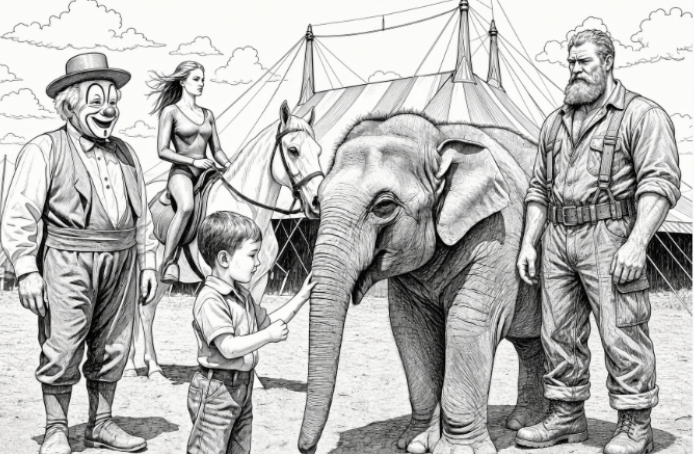
There was Carlos, the first real Mexican I’d ever met (even though he’d quickly remind you he was a Tex-ican who just happened to be born in Mexico). Carlos had an incredible skill with horses; his wife, a former beauty queen who almost became Miss Georgia or Miss South Carolina or something like that, was our featured rider. I was as head over heels in love as any kid would be with her long blonde hair and pretty smile, but Carlos was my friend, so I gave up on all ideas of running away with her.
Pete the mechanic played the drums and about any other instrument you could hand him, drove a truck (we had five semi-rigs) and did other such things. I once heard him playing a mournful flute long after everyone else had gone to bed, the song totally unlike anything else I’d ever heard.
We had the oldest working clown in the world (everyone needed a hook, but our clown’s hook was the truth). Our clown also managed the elephants, llamas, and a couple of other critters at the petting zoo. I always enjoyed helping him, because his wife reminded me of my grandmother when Miss Myrtle was in a good mood.
My best buddy, however, was a big red-haired Pennsylvania Pole named Scott. Everyone called him Kazoo, because his last name was too complicated.
Kazoo taught me some of the patois of the circus, carny-talk as some people like to call it. He “pushed the jenny” (translation: drove the generator truck) and could weld or fix just about anything.
Kazoo would steer me away from the crew quarters on “break nights,” the times when the circus-folk didn’t have a show and weren’t traveling.
Kazoo was polite to my folks, made Momma laugh (which was a feat that year) and kept comic books and Mad magazines in his sleeper. Kazoo also had a small library of Faulkner, Shakespeare, Hemingway, and authors I can’t recall tucked away in his truck.
Kazoo led our Black Gang, the people who never stood in the spotlight, the ones who set up the tents and ran the lights, then stepped back while the performers took to the rings. The Black Gang didn’t associate with the visitors, and barely associated with the other circus folk. I became a member of the Black Gang, those who stood above such petty things as performing and washing our hands too often.
It was amazing to me how quickly bleachers for 300 people could be constructed, and with Kazoo’s jenny growling in the background, a ballfield or parking lot would become a little piece of paradise where a few hours before there had been nothing.
It was a great big magic show, and if I couldn’t be the magician, at least I was one of the assistants.
But just like every three-day run with a parade and two matinees in a tobacco market town, the show had to end. Mr. Robert ran out of money, and dreams aside, he quickly realized that it’s hard to pay the bills if you can’t get the show on the road. Since a new school year loomed, Momma and Papa reclaimed me for good, rather than just bringing me home on Sundays.
I noticed Papa making more trips to the field our circus called home, waiting on Mr. Robert, rather than taking his long trips across the state, talking to fire departments and civic clubs about the circus. Mother, too, made some of those trips to the circus field, but she usually carried boxes of groceries and huge pots of soup.
One day Carlos and his beauty queen went to South Carolina to get some big cats – lions and tigers that would transform our show. They never returned.
Pete won some money gambling; he unceremoniously unloaded his buddy’s gear from a van, squalled slick tires and he spun out of the parking lot.
Our clown and his wife had plenty of their own money. When a promised load of hay for their elephants never showed up, they bid us all farewell, loaded up their animals, and headed for the interstate. A few years later I happened to see Mr. Mac’s obituary; they had retired to what was called Circus Town in florida.
And then one day, Kazoo cranked up his big truck, shook my hand like I was a grown man, and pulled out.
The circus died that summer, drifting apart like the cheap paper around a magician’s bouquet of disappearing flowers. Before long all that was left were a few packs of promotional matches, some letterhead, and a handful of posters.
Years later, Miss Rhonda and I took a shortcut down a service lane at the State Fair. I wanted to show her the carny row, the line of campers where the gypsies lived. In addition to the neat and oftentimes whimsical campers, there were cables and water hoses everywhere, along with a bunch of rather rough looking folks with loud voices.
One big, older man with a wild shock of red hair and a full beard, both heavily streaked with gray, was working on an electrical box with two or three other folks. The red-haired fellow stared at my hat, then my face. We nodded at each other, and both groups moved on.
I regret that I never went over to see if that was Kazoo; the chances were slim at best. Hundreds of people still eke out a living with circuses and fairs, and there could well be many red-headed fellows with broad shoulders and a skill with generators still “riding the circuit.”
Besides – he was a member of the Black Gang, and far above speaking to ordinary people. It would have been presumptive of me to approach him with clean hands.
That poster in that old store window took me back better than any time machine created by H.G. Wells (Kazoo had that book, too).
The fears and uncertainty of the spring disappeared under a big top festooned with colored bulbs and held up with tent poles painted by hand. I was in love with a beauty queen who rode horses, I could feed elephants and llamas every day, and I had a best friend named Kazoo.
What more could a boy want than to run away with the circus, even just one more time?