RALEIGH – The N.C. Department of Agriculture and Consumer Services has confirmed the first established presence of the invasive yellow-legged hornet (Vespa velutina) in the state.
The hornets were found in Matthews.
Adult hornets were recently reported after the homeowner noticed suspicious hornet activity at her hummingbird feeder. A follow-up survey found additional adults near the Union and Mecklenburg county line. Survey, trapping and response efforts by NCDA&CS and USDA-APHIS-PPQ are ongoing.
Because yellow-legged hornets attack honeybees, they can cause reduced foraging and colony failure, said State Apiarist Don Hopkins. “This would result in reduced honey and other honeybee products, reduced crop production due to decreased pollination by honeybees and native pollinators, making the hornet a serious threat to North Carolina’s beekeeping community,”
NCDA&CS has been monitoring for yellow-legged hornet since it was first detected in the United States in Savannah, Ga. in November 2023. The aggressive pest of honeybees and other pollinators had been previously localized near Savannah and Charleston, S.C. until a population was identified last December in York County, S.C., just south of Charlotte, said Dr. Bill Foote, director of the NCDA&CS Plant Industry Division.
“This detection prompted us to ramp up surveillance this year in southern Union and Mecklenburg counties,” Foote said. “North Carolina has thousands of beekeepers statewide, and our apiary team has been working diligently to alert them to the threat yellow-legged hornet poses to their hives.”
Beekeepers are asked to keep watch for hornets around hives exhibiting “hawking-like behavior.” This behavior is a distinctive characteristic to the yellow-legged hornet as they prey on bees.
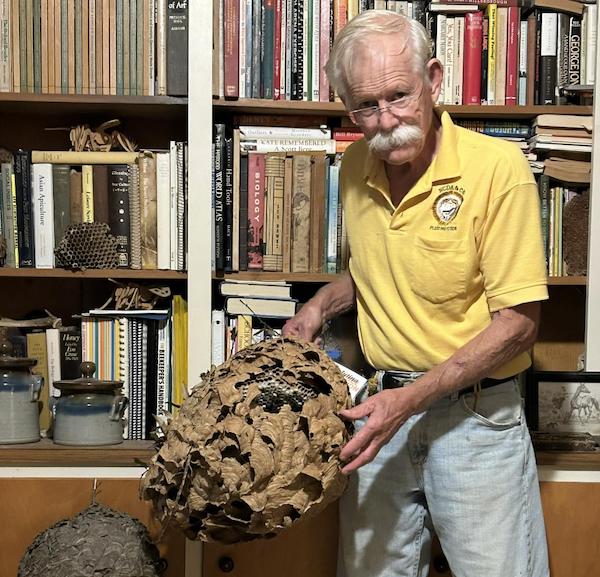
Their hives are another distinctive feature, as they can grow much larger than other hornet nests and have a reddish, muddy color to them compared to gray colored nests of bald-faced hornets for example.
At this time in the season, Foote said, hives would likely be the size of a volley ball, although they can grow in size to fill a pickup truck bed.
NCDA&CS is working to locate and remove the yellow-legged hornet nest to prevent further spread. More than 200 survey traps have been set in the area surrounding the Union County home where the adults were spotted to target the nest and find additional populations.
Homeowners and beekeepers throughout North Carolina are encouraged to visit www.ncagr.gov/YLH for instructions to build, report and monitor traps on their property.