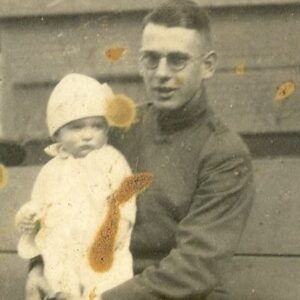
They stand frozen in time, two men far younger than I am now, Gary Cooper-esque smiles under dark eyes.
The taller of the two is my grandfather, W. Thomas Weaver. My dad was 2, leaning to 3, when Grandfather sent the photo home from France in 1918.
The men wear Sam Browne belts over heavy coats, puttees laced to their knees, battered wide-brimmed hats at rakish angles. They stand in front of a large, bullet-pocked stone wall.
The fading handwriting on the back is not the precise Spencerian script of my great aunt or grandmother, but rather the scrawl that my grandfather somehow passed down through his son to a grandson he would never meet.
“Tom Weaver, after the fight. With Frank, who saved your daddy’s life. Later killed by Germans.”
Just as I always think of my grandfather on Veteran’s Day, I think of Frank on Memorial Day.
I do not know Frank’s last name, where he was from or anything else. All I know is he saved my grandfather, who apparently had a propensity for getting into dangerous situations.
Tom Weaver survived gas, bullets, shrapnel, fire, cold, and being stabbed, only to be killed by a trolleycar back home in Washington City in 1919. I like to think he would have appreciated the irony.
Frank died in combat, apparently with my grandfather, in what was dubbed “the War to End All Wars”.
Memorial Day is when we remember those who gave their lives in the service of this country; all too often we forget that fact, even now when we still have young men (and now women) dying on foreign fields.
Men like my Uncle Jim’s fellow gunner Pete. They were on a B-25 over Africa when Pete took a direct hit from a German 20 mm cannon. The German pilot was spiraling down into the desert of North Africa to his own fate when he squeezed off one last burst.
I’ve told you before of a fellow named Kyle Stout, who served beside my “Nevoo” John Thomas and his friend Anthony Verra in Afghanistan. John came home with injuries that will plague him all his life. Anthony lost his legs. Kyle was killed, as was their lieutenant, a fellow named Todd Weaver, who became somewhat famous for a letter to his young wife. He was no relation, but I‘d be proud to call him kin. Enough of John’s brothers died that they have a memorial stone at what was their home base.
A couple weeks ago, I had the honor of attending a funeral for a sailor from Columbus County. William Burns died when his destroyer hit a mine and was stuck off the coast of France during D-Day in 1944. He is thought to have been one of the skeleton crew who stayed aboard, trying to repair the ship and still provide cover against German aircraft as Allied soldiers first took the beaches, then began moving men and material in for the final blows against Nazi Germany.
The ship was finally sunk by German artillery. His remains lay aboard the ship until they were discovered by a scrap crew. Just recently he was identified and brought home to be buried at Chadbourn. More than a dozen of his shipmates are still missing.
Like my grandfather and his friend Frank, all of the young men I mention above volunteered. John even fought to get back in the service; he had previously been discharged from the Navy after an injury. Tom came home to his wife and family, at least for a little while. His nephew whom I knew as Uncle Jim made it home too, and went on to have a family and a successful career. Anthony came home to one of the bravest women I’ve ever had the pleasure to become acquainted with, his wife Shauna, and a beautiful baby girl named Scarlett. They have a son now, too. John came home to start a new life as a civilian. His dad Gil didn’t go to Vietnam, but he helped bury many of the fallen when he was part of the Caisson Unit at Arlington Cemetery, as was my friend Larry Hammond.
Frank, Pete, Todd, William and Kyle went to their eternal homes.
I am still haunted by something I heard from Vietnam veterans I had the honor to interview during the 50th anniversary of that war. They would make mention of someone with whom they ate, slept, fought, prayed, laughed and sometimes caroused, only to end the story with the words, “He got killed when we…..”
We heard plenty of war stories growing up, although the World War II and Korea veterans were dealing with young boys eager for adventure and patriotism, so the stories were somewhat sanitized. As a Cub and Boy Scout, I was one of those placing flags on veteran graves every Memorial Day and Veterans Day.
I had to grow up to be able to see the hurt in the eyes of those who answered their country’s call.
I have never served in the military; none of the services wanted me, since my hearing wasn’t up to snuff. I have had friends my own age and younger die, including a couple of police officers and firefighters who were killed in the line of duty. But that’s different.
These men were my friends, yes, but we never could have the connection of those who left home to go to a foreign land because their country, the country they loved, offered them a substandard salary, middlin’ benefits and the chance to get hurt or killed protecting a sometimes ungrateful nation. That call is different, and the sacrifice is different as well.
I wish I could tell the story of the man named Frank, just as I wish I could tell the stories of Pete, Kyle, William and Todd. I don’t know all their lives and to be real truthful, I don’t know that I have the right to even speak their names.
I hope as you enjoyed Memorial Day, you at least took a moment to think of the men like Frank. I hope you did as I did and prayed for those left behind when men stormed ashore at Normandy or some Pacific atoll, knowing their bodies were paving the way for their buddies who followed.
Men like the unknown sailor buried on the Burgaw courthouse square. Men who heard the distinctive ping of a final clip ejecting out of an M-1 Garand rifle in the night, then fixed a bayonet one last time on a Korean hilltop. Men who laid down fire covering a landing zone for a helicopter, knowing full well there might not be time or room for one more passenger. Those who stayed behind when that Huey or Blackhawk lifted off, so there would be room for a wounded buddy. Men who saw how little life was left in a damaged airplane but still stayed over the target because those on the ground needed their protection. Men who wiped sand, grime and blood from their faces and tried to tell friend from foe in places many couldn’t have found on a map before Sept. 11, 2001.
Memorial Day is not about barbecues and beaches and fishing and fun and families; it’s about those who gave their all so we could enjoy those things.
On second thought, maybe we should enjoy Memorial Day; after all, those folks whose lives did not last to the end of their tours did not serve for themselves. They served so that their families, friends and generations of people they would never know could enjoy all their country had to offer, in freedom and without fear.
I doubt many died with smiles on their faces knowing they had become martyrs on freedom’s altar, as another writer put it on a bloodstained notebook, but I pray that we as Americans never take for granted the men who made us great.
Men like Frank.