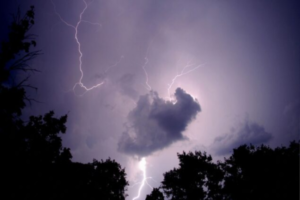
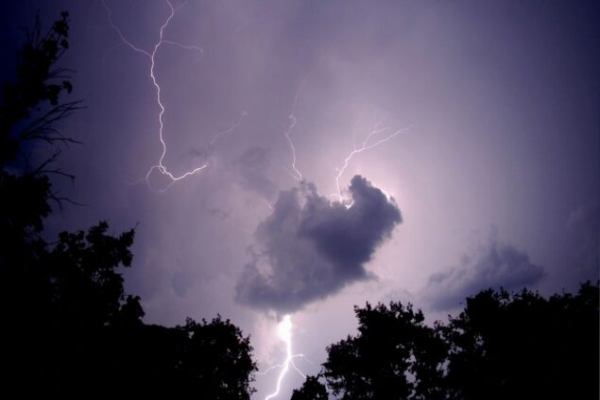
Lightning today may mean a wildfire tomorrow or even weeks down the road, according to the N.C. Forest Service.
Last week’s Quarry Road fire in Brunswick County has been tracked down to a lightning strike, according to Christie Adams of the NCFS.
“While the cause of the Quarry Road Fire in Shallotte was determined to be lightning, our investigation is ongoing and has not concluded at this time,” she said.
The 284-acre fire destroyed two buildings and a number of vehicles, and forced evacuations in several communities. Columbus County fire departments supplied resources to help the NCFS and Brunswick departments fight the blaze, along with units from four other departments, Horry County, S.C.
Lightning is always a threat during wildfire season, but this year has been worse, Adams said.
“With the prolonged drought and lack of wetting rainfall, lightning ignition efficiency is enhanced,” she explained. “This means there is a greater probability that cloud-to-ground lightning strikes ignite a wildfire.”
The extreme temperatures of the past few weeks have aided in the drying out of fuel such as leaves, pine straw and downed trees and limbs, especially in areas of large dead trees and what experts call “deep duff dryness.”
Duff is the layer of decomposing organic materials above the mineral soil but just beneath the litter layer of twigs, needles and leaves.
“It is ground fuel for wildfire,” Adams explained.
Because the organic soil, commonly called peat, is tightly packed and has less oxygen than surface litter, duff typically smolders instead of burning quickly.
“When it’s wet, it’s not as receptive to fire,” she said. “When it dries out, it can burn underground, smoldering, slowly spreading without flames for days, even weeks.”
Among notable North Carolina wildfires, Evans Road in 2008 and Pains Bay in 2011 were lightning-induced wildfires in areas rich with organic soils, Adams said. These fires ignited during periods of persistent and prolonged drought, burned for weeks and consumed more than 40,000 acres each.
Lightning “holdover” fires are wildfires that can remain dormant, like a ‘sleeper,’ typically smoldering underground, not presenting flames, she explained Holdover time is generally defined as the span of time between the lightning strike/smoldering phase and actual detection.
“With lightning holdovers, it can mean days, even weeks of dormancy,” she said. “Latent heat is kicking around in available fuels such as standing dead snags, woody debris, root systems, true organic soils or deep duff. Dry, warm or windy conditions can wake these holdovers up, stir embers up, bring ground fire to the surface and result in an active wildfire.”
Generally, when officials suspect a lightning strike as an ignition source for wildfire, they look for damaged trees or vegetation, isolated origin points and concurrent meteorological data. Multiple cloud to ground lightning strikes were reported in the entire region July 9, the day before the Quarry Road fire was spotted.
Quarry Road was listed as 50 percent contained as of noon today (July 15). Another large fire in the area, the Overlyon Road blaze in Bladen County, stands at 20 percent contained and 89 acres.
No burn bans have been issued for the area. Despite heavy rainfall in some parts of the region in recent days, drought conditions are expected to continue to worsen.
Copyright 2026 Columbuscountynews.com. All Rights Reserved.