Richard Dean is used to seeing herons and other water birds in the ditches and pond at his home on U.S. 701 in Williams Towsnhip, but not pelicans.
“I never saw one up close before,” the U.S. Army veteran said.
Dean said his mail carrier called Thursday morning about when both thought was a great blue heron in the ditch in front of the Dean home. The bird appeared to be having problems. Dean went out to see if the bird needed help.
“I knew right away that was no heron,” he said.
Dean, his wife Holly and daughter Sarah worked together to secure the frightened young pelican. They caught her with a blanket and carefully put her in a dog kennel with water, in a shaded area.
Then they began looking for help.
The Deans contacted Sea Biscuit Wildlife Sanctuary at Oak Island. Mary Ellen Rogers, the founder and director of Sea Biscuit, usually sees several pelicans a year. The birds commonly get caught in fishing lines or when foraging around areas where human anglers are fishing. Some get struck by boats. Others are rescued when they are sick or hurt.
But the big-beaked birds are a coastal species, rarely seen outside of the estuarine areas. She frequently gets calls from Myrtle Beach to New Hanover County about pelicans with beak injuries or other problems.
“But not from Columbus County,” she said. “This is a first.”
Pelicans rely on large quantities of fish for food, and they commonly prey on schools of spots, pogies, menhaden and other small fish. Bream, crappie, bass and freshwater minnows have different patterns than saltwater species. While pelicans do hunt for fish, they aren’t equipped to wade and spear their prey like herons, egrets and storks.
“If one could survive in a pond,” Rogers said, “the fish would be gone pretty quickly.”
Rogers contacted a volunteer from Columbus County who regularly transports owls, hawks and songbirds to Sea Biscuit for rehabilitation. The volunteer didn’t have all his necessary equipment with him, however, and contacted Families First, hoping to purchase a used pillowcase from the Whiteville thrift store.
Vickie Pait, Lucy Byrd and the staff immediately gathered up not one but two pillowcases that were no longer needed at the shelter where they house families recovering from domestic abuse.
Transporting larger birds in pillowcases is a common way to safely confine and calm and injured bird, Rogers said.
“They can’t see what’s going on,” she said, “and there’s less chance of either the person or the bird being hurt.”
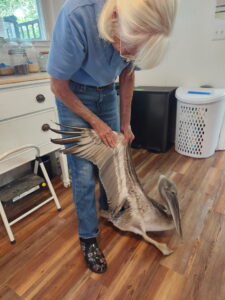
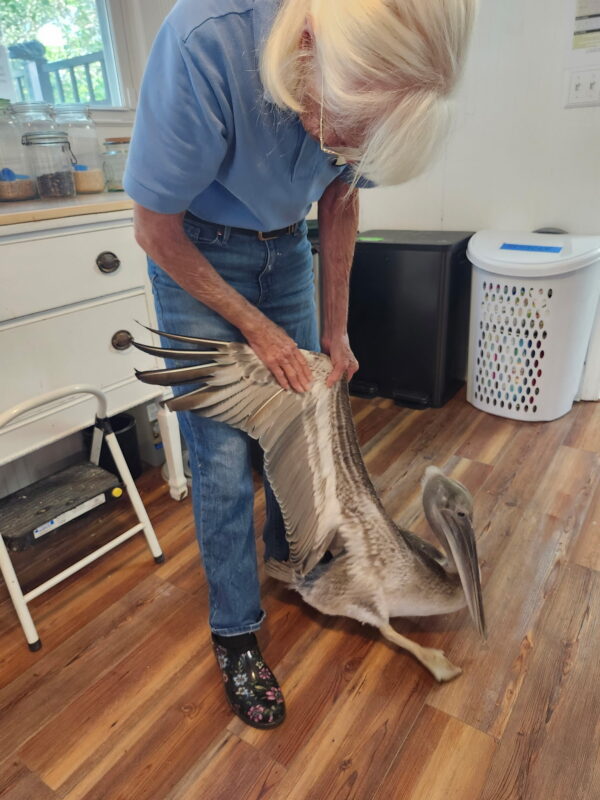
The pelican turned out to be an adolescent female, Rogers said, and is the first fledgling brought into the shelter this season.
“I don’t know how the poor girl ended up so far from the coast,” Rogers said. “They have a big range, but they stay close to large bodies of water, so they can fish.”
Byrd said Families First was pleased to be able to help.
“Our agency is pet-friendly, so we love good rescue stories,” Byrd said. “We’ve never helped a pelican before, though.”
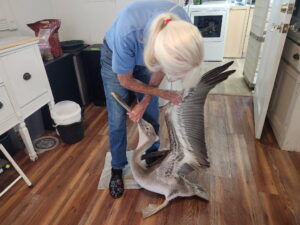
The pelican appeared to have only a minor foot injury. After she was evaluated, she was placed in a recovery pen at Sea Biscuit, where she can see the other resident pelicans as well as flocks of the big-beaked birds flying over the shelter from the nearby salt marsh. She was set to receive a more thorough examination after some rest and fresh fish.
Rogers noted that in years past, a pelican was observed at Lake Waccamaw after a tropical system blew the bird far inshore, but a young pelican like this one would not normally have been so far from adults who can teach it how to survive. Unlike wading birds, which often are loners, pelicans live in flocks and rely on their extended families for safety as well as food.
“I’m sure she has a story to tell,” Rogers said.
Sea Biscuit is a non-profit and supported entirely by donations. For more information about the rescue, go to seabiscuitwildlifeshelter.org or follow them on Facebook.