By Burgetta Eplin Wheeler
NC State Veterinary Medicine
Photos by John Joyner / NC State Veterinary Medicine
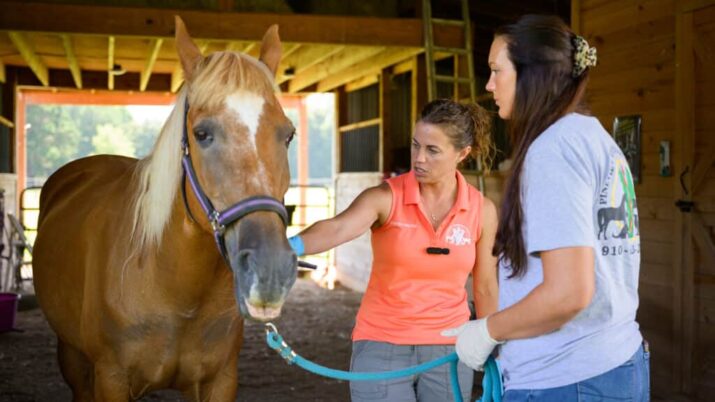
Before heading home each day to the family farm outside Chadbourn, Christine McPherson Long would leave West Columbus High School, cross the street and spend time at the local veterinarian’s office, where to her great ninth-grade joy, she had snagged a job cleaning cages.
“It was on from there,” says Long, now a veterinarian serving her neighbors through her practice, Pineview Veterinary Hospital near Bolton. “I never really did anything else.”
On to NC State University, where she majored in animal science, and on to the N.C. State College of Veterinary Medicine, where she earned her DVM in 2011.
And now she has moved on to mentoring new generations of critically needed large animal veterinarians through the college’s Randall B. Terry Jr. Rural Veterinary Scholars Program.
In the rural areas of North Carolina and the rest of the country, warning sirens are blaring as increasing numbers of livestock and family pets continue to have fewer veterinarians to care for them. The crisis led the USDA last September to launch the Rural Veterinary Action Plan, an initiative to increase the number of rural food animal veterinarians across the country.
Just this month, the Bovine Veterinarian published an article titled “We Need More Rural Veterinarians. Are We Looking in the Wrong Place?”
Answering the call, Dean Kathryn Meurs created the rural scholars program in 2024 to help expose more NCSU veterinary students to careers in rural medicine. Rural practices often can’t afford to pay student interns, so the 10-week summer program includes a stipend plus room and board for rising second- and third-year students interning at rural practices across the state.
This summer, seven veterinary students have been putting their classroom lessons to use helping North Carolina residents and their animals at eight rural practices:
- Whiteville native Meredith Moss has spent the summer at Pineview Veterinary Center, while Emma Knox at did her first five weeks at Pineview before moving to Henry River Mobile Veterinary Services in Catawba County.
Pineview Veterinary Hospital has two clinic days a week at the hospital on Green Swamp Road (N.C. 211) and offers mobile service every weekday across numerous North Carolina and South Carolina towns and farms.
Long eventually bought the practice from her own mentor, Dr. Heidi Hart — also a Columbus County native and NC State DVM alum, class of 2002 — after returning home to work there after she earned her DVM.
“She started the practice herself, independent, with a truck, a box, and hit the road,” says Long, who notes that she was building a house and pregnant with twins when she took over from Hart. “She built the facility we have in 2005, and we’ve evolved from large animal exclusive to mixed animal. We do everything now.”
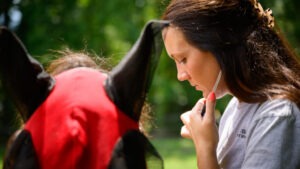
Long frequently provides opportunities for would-be veterinarians to shadow her, no matter their age or location, so she eagerly welcomed the two N.C. State rural scholars into her practice for the summer. Being a good mentor and role model is deeply important to her.
“Honestly, they make me a better vet,” she says. “They ask some of the craziest, but sometimes most poignant questions you could ever not think of, and I love that. We sit in the truck and they’ll ask me something I don’t know, and I say, ‘Let’s figure that out,’ and then give them that little temporary homework assignment, but you work together with it and then I’ve grown and learned something and they have, too.”
The national shortage in rural veterinarians most often is attributed to high student debt in relation to significantly lower pay (compared with urban small-animal vets) and to difficult working conditions. Long doesn’t sugarcoat her truths but hopes her mentees look at her and see what’s possible.
“You can do whatever you want to do, but don’t think for a second it’s going to be easy,” she says. “Your version of ‘hard’ is definitely yours to kind of dissect. And you give yourself grace and forgiveness when you make mistakes, and you realize that the relationships made along the way are the most important thing.”
Knox and Moss agree that the people — whether the clients, the veterinarians or the staff members — have been one of the best parts of their experiences.
Knox has known she wanted to be a veterinarian since kindergarten. During COVID, she worked in the livestock section of an animal rescue. When she arrived at NCSU to earn her undergraduate degree in animal science, she began working on the campus swine and dairy farm.
”I just fell in love with farm animals, being outside doing all the things with them,” Knox said. “Food animals are my favorite area to work. I really admire the people in the field, and all of the work that they put in for making sure that we are fed and that the animals are taken care of at the same time. The drive to do that, and to work so hard at it, I admire the field a lot. I have a lot of respect for the people in it.
“I hope to stay in North Carolina. I was looking at mixed animal practice, so I’m doing my first five weeks at Pineview Veterinary Hospital and then my second five weeks at Henry River. Both of those are mixed animal practices, and I feel like they fit the needs of the community really well. I like the variety in the species that you get to see within a day. On Thursday, we had a horse, a cow, a goat, a sheep, an emu, a dog and a cat, and that was just very exciting.
“I enjoy seeing how they make it work with the balance between the office days and the days on the road and the farm truck. They love to teach, and they love to share their knowledge and their experience, and they want to get us vet students excited about working in rural areas and excited about doing the mixed animal practice as well, because they recognize that there aren’t as many opportunities for students to go do that in North Carolina. You can’t really put a price on that hands-on.
“I’ve gotten to work on palpating cows. I’ve gotten to do horse dentals. I’ve gotten to trim pig feet, got to stitch things up, gotten to participate in some of the surgeries, so they’re really good about getting the students involved. They’re not forcing you to do anything, but if you have an interest in it, they absolutely are going to help you do that.
“Without the rural scholars program, I would have had to make a decision to take a job somewhere else this summer.”
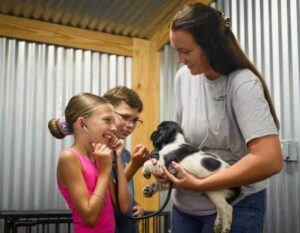
Moss, who is simultaneously earning a master’s in public health, is from Whiteville. Long has been her family veterinarian throughout her life.
“I have been fully immersed in rural medicine my entire life,” she said, “but never in a veterinary way. My dad owns a feed store. Anytime you’re working with a lot of different farmers, there’s the farmer-vet relationship, farmer-feed store relationship, and from a young age, I’ve always heard producers talking about what to feed, how to feed, cost efficiency and kind of also like what their veterinarian recommends, balancing that with what’s available and what’s cost effective.
“I’ve always been around this conversation, I’m just seeing it from a new side now.
“You can do a lot of really cool jobs as a veterinarian who also studies public health. I work a lot on the One Health side of public health, as in, how can we ensure our meat quality is the best? How can we ensure food supply chain, because we need those producers on small and large scales to keep up with an ever-growing population, and then you have to think about animal shelters and floodwaters and emergency preparedness. My corner of public health is emergency preparedness for veterinarians and animal producers that can help protect humans as well.”
Pineview further broadened her horizons, Moss said.
“I’ve been able to do spays and neuters and assist in a lot of small animal surgery,” she said. “I’ve been able to do a lot of equine dentistry, flooding teeth, a lot of herd work, which has been new to me because I’ve never worked with cattle outside of the hospital. “I’m learning how to set up mass vaccines, pregnancy check documentation and then handling anything that comes in.
“We had a client who brought a pet chicken in for an X-ray one day in a laundry basket. There have been a lot of pet pigs that need management, that need hoof trims and just really interesting things that come up when you’re keeping a pig as a pet that I’d never thought about before.
“You can go own a veterinary practice, but you really can’t go own a hospital. And I just love the ability to be a dentist and a pharmacist and a radiologist and a reproductive health specialist all in one day. With human medicine, everything is so sectored out you have to specialize in one thing or another, and there’s really no crossover. But being a vet, you can learn and do everything.
Moss said her most important lesson was helping low-income clients.
“I grew up seeing the animals in my community and working in the animal shelter,” she said, “and a lot of people can’t afford the veterinary care that we’re taught to give, so it was really important to me to go back to that community and learn what’s the best you can do for them, working with a low budget, and kind of learning how to stretch dollars and clinically reason in a way that allows you to best spend the owner’s money.”
This is an edited version of the story posted on the NCSU website. For the full version, including additions interviews, go to https://cvm.ncsu.edu/news/learning-the-rural-ropes-across-nc-veterinary-students .