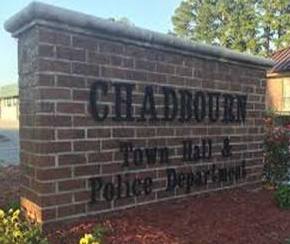
In a three-two vote Monday, Chadbourn Town Council refused to discuss proposed attendance rules and ethics policies, along with an amendment to the town charter that would have made provision to remove elected officials.
Clewis made the motion to remove the three items and replace them with a closed session on personnel. Mayor Pro Tem Tony Jordan seconded the motion. Avala Nealy, Jordan and Clewis voted in favor, while Rashad Roberts and Colene Kelly voted against it.
The proposals would have created a path for removing elected members of the board (see related story, as well as setting a mandatory attendance policy. Another proposal would have set up ethics training for the board in accordance with state standards, similar to those already in place for employees and appointed boards.
The measures had been placed on the agenda by Town Manager David Wise after consultation with Mayor Phillip Britt.
The ethics proposal called for showing respect to members of the public, staff and council, avoiding conflicts of interest, and other basic rules. The attendance policy is a standard used by multiple municipalities in the state, and calls for board members to be at a minimum of 75 percent of the called and regular meetings in a fiscal year. Excused absences would not be penalized. Council members with three unexcused absences could be removed from the board by a simple vote.
“Why do you want to do this?” Nealey said. “This is kind of hard.”
Clewis said he did not feel the council needed to discuss the three topics.
“You’re saying that you don’t need to go over them,” Kelly said.
Roberts noted that Nealey, Jordan and Clewis “have the votes to do anything they want.” He was in favor of discussing the changes. He said the board members were elected as part of a “democratic process,” but wanted to use “back doors and closed doors” to circumvent the open meetings process.
He also called out the other members of the board for not being willing to establish a mandatory attendance policy, ethics training or to consider the recall rule.
“You have the majority,” he said. “…you can vote to remove things you don’t want to talk about in public. It doesn’t make sense to me that you don’t want to have these (changes)…They all attest to making sure elected officials are doing the right thing.”
“You don’t have to look at TV to see what’s wrong with America,” Roberts said. “We can look right here.”
Britt noted that the request for a closed session on personnel was made to the town attorney, not the town manager or mayor, and it did not come with a reference to the necessary statute.
“That’s why I didn’t put it on there,” Britt said. “There’s a proper procedure. Why do you want to have this closed session? What is the statute for it?”
Clewis said it was for “evaluation” of an employee, but did not name which employee.
Clewis, Nealey and Jordan have sparred with Wise over water bills and zoning issues since he came to work for the town in June. He is not contractually due for a performance evaluation until six months after his start date.
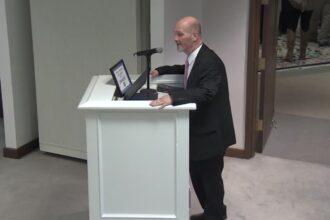
As the council prepared to go into the closed session, Wise asked to speak to the board in the open meeting. He noted that his contract, which was signed June 4, explicitly states evaluations are to take place at six and twelve months, and require a written evaluation from both the board and Wise. Those are then compiled into one report.
“This is a direct violation of my town manager’s employment agreement,” he said. “This personal performance review of yours is retaliatory in nature being initiated for a number of reasons.” He noted that his termination has to be taken “on the public floor,” not in closed session.
Britt said discussions would take place behind closed doors, per GS 143318.11, consideration of qualifications and fitness, or to investigate complaints against a town employee. Clewis made the motion to go into closed session, with a second from Jordan. Nealey voted in favor. Roberts and Kelly voted against going into closed session.
After an hour-long closed session, Britt said the council took no action, and the board adjourned the meeting.
Copyright 2026 Columbuscountynews.com. All rights reserved.